Saturday, April 7, 2012

Staying grounded in Thailand

There's a great scene from the movie Best In Show where two of the characters, Hamilton and Meg Swan talk about how they met at Starbucks.  Not at the same Starbucks, different Starbucks across the street from each other.  Thailand is like that but only with 7-11s.
They are everywhere, at least in the two cities that we have spent the most time in while in Thailand, Bangkok and Krabi.  According to Wikipedia, there are about six thousand 7-11s in Thailand, with HALF of those being in Bangkok.  That's a lot of Slurpees.  By comparison, there are about eight thousand 7-11s in all of the US, and Thailand is roughly the size of France and slightly smaller than Texas.  It's such a part of the culture that in almost all of the shops selling t-shirts, you can purchase one with the 7-11 logo on it, and we saw more than one taxi driver sporting such a shirt.

Our world travels up to this point have also educated us on Pringles.  They've been available pretty much everywhere we've been so far, even in the carts of vendors selling drinks and snacks on the streets of Vietnam.  Ben and Marley have discovered that there is more than one variety of Pringle, and I don't mean variety of flavors.  The "real" Pringles are the ones with a red and white logo on the paper cover that you peel back at the top of the can to get into the delicious salty snack.  The imposter Pringles have just a plain white paper cover under the plastic lid at the top.

There is a definite taste difference between the two.  Ben and Marley have further determined (thinking about all this makes me realize how many cans of Pringles we've eaten along the way!) that even the "real" Pringles can fall short of the ones we get back home.  If the top of the can is taut or feels like it's puffed up with air inside, they've probably been sitting on a container ship somewhere for a while and are going to be stale.  Who needs home-schooling when you've got these kinds of thought processes going on?

One of the most enjoyable aspects of our stay in Bangkok was the size of the apartment we rented.  We managed to find a very affordable two-bedroom serviced apartment in the Pantip area of the city.  Our mouths collectively hit the floor as we walked into the place for the first time.  

It featured a large living area with a dining table, plus a big kitchen. Both of the bedrooms were about as big as the entire rooms of several of the places we stayed in Vietnam and Cambodia.  Since late February when we left Australia, almost every single one of the places we rented saw us all sleeping in one room.  The best bed configuration in those instances was one large double and two singles.  We had that in Phnom Penh, Cambodia and in Hoi An in Vietnam.  Other times, when there are three cozy doubles, we usually have Ben and I in our own beds and Marley and Annie snuggled up in the third double. 


 Despite the close quarters, we all got used to sleeping like that and would frequently do the "Good-night Jim-Bob" routine right after turning out the lights each night.

After a few weeks of that, all three of us were really glad to have some room to spread out in Bangkok.  In what has become something of a pattern for us, we laid low our first day in Bangkok following a long travel day the previous day.  In an effort to save money, we booked a bus ticket from Siem Reap to the Cambodian border town of Poipet.  We had made friends through other friends of a Canadian native who had lived in Siem Reap for about 11 years.  He suggested that we take the local bus to Poipet, walk across the border, and buy another set of tickets for the bus ride to Bangkok.  We was going to be going the same way the same day and thought we would enjoy taking the bus ride together and he would help us cross the border into Thailand since he was spending the night in Poipet and leaving for Bangkok the following day to fly back to Canada.

Well, something got lost in translation with our local fixer/tuk-tuk driver Ratana, and the ticket we wound up getting was not on the same bus as our Canadian friend, Roy.  The day started early with a 6am wake up call and we had bought the bus ticket to Poipet through our hotel, which promised free transfer to the bus station.  The transfer vehicle turned out to be a pick up truck with a padded bench seat on each side of the bed. 
The pick up truck took us to a bus that was parked among a couple of buses on some side street.  We've done our best to go into "jellyfish" mode so far on the trip and we rolled with the flow in this instance, asking the men throwing our luggage on the bus if this was going to Poipet, and after being assured that it was, we got on board and figured we would look for Roy when we got to the border.  Once again, Ben and Marley never complained or whined about our transporation arrangements, despite looking like we were on a family outing in West Virginia.


Four hours later, and still a short ways away from the Thailand/Cambodia border, we got off the bus and I managed to track down a ticket handler and, with Roy nowhere in sight, go ahead and secure four tickets to continue on to Bangkok.  We paid more by splitting up the ticket instead of just paying for direct to Bangkok, but it was still only about $18USD per person.  

Fortunately, when we got to the border, Roy was there waiting for us, with his adopted son Sinin.  We lamented over how the ticket buying process didn't work out the way we hoped, but were happy that we still got to where we wanted to go.

That's us with Roy's brother on the right and his son, Sinin, on the left as we get ready to walk our luggage across the border into Thailand, and hopefully get on a luxurious, air-conditioned bus to Bangkok.

After being properly dismissed from Cambodia and going through the necessary documentation to get into Thailand, we met back up with the ticket seller, and the two dozen or so passengers and our luggage were put on pick up trucks and taken to a restaurant/rest stop for lunch.  We were told cheerfully that the bus would be along in a half hour or so, giving us time to eat and enjoy the local restroom facilities.  I'll just say this: at least the food was okay.
While we waited, different groups of people that were on the bus were put on mini-vans that held about a dozen people, and drove off at different times.  I haven't ridden commercially on buses all that much, so I'm not exactly an expert but I started to think that maybe the mini-vans were going to be our mode of transportation to Bangkok.  The four-hour ride to Bangkok.  

Sure enough, after waiting for close to two hours, on a day where we had gotten up at around 6am and already been on a bus for four hours, we found ourselves in the back four seats of a mini-van that would take us to Bangkok.  The van was WAY over-packed, as our feet rested on our backpacks and luggage, and the aisle that went to the doorway was filled with more suitcases.  
Fortunately, none of us has any degree of claustrophobia and so we managed to endure the trip without imitating a psychotic Jet Blue pilot.  There were a few stops along the way for fuel, and at one of those we enjoyed some very tasty chicken prepared by a road side vendor.  It was also just nice to be able to get some fresh air and stretch our legs a bit.

The van/bus arrived in Bangkok after dark in an area where some taxis were parked.  We managed to communicate where we were going and the driver took off into rush hour traffic that just crept along and made a long day even longer.  But the extra forty-five minute wait was worth it as we got to our roomy accommodations, which put a smile in our faces and a song in Marley's heart.  The 16th floor apartment had a roomy balcony with a nice view of Bangkok, providing a nice backdrop for the videos she likes to make of her singing Taylor Swift songs.  Check out her Facebook page, they're actually pretty good, her dad said humbly.

One of the best ways to get around Bangkok is to take a boat along the Chao Phraya River.  They're cheap, roomy and run frequently along the river, providing a good view of some of new and old buildings along the banks.

We took the boat in hopes of seeing the Grand Palace, a massive complex of temples not far from the Tia Thien stop on the river.  Unfortunately, the temple complex was closed to the public for the day to rehearse for the funeral of a cousin of the king, so we had to adjust our plans. 

After a quick lunch at a sidewalk cafe, we went into a smaller but still impressive temple complex called Wat Pho.  It features a reclining Buddha that measures about 46 metres long and is covered in gold leaf.  With Easter Bunny season approaching, I resisted the temptation to attempt to peel back the gold leaf and see if it was a Chocolate Buddha.  Instead, we went along with the local custom and bought a small cup of coins and deposit them in the fifty or so pots that line one side of the long room holding the Buddha.  We weren't sure of the significance of what we were doing, but it was fun to be part of the sounds of the coins dropping into the pots.

The complex was striking, with several temples and many Buddha statues.  Some of the temples were closed to the public, but we still got to get a good look at many of them.  

We couldn't stay too long at Wat Pho because we had a dinner date to get ready for.  A friend of a friend married a man from Thailand and after spending the first 19 years of their marriage in Cincinnati, they decided to take their 14 year old daughter and their jewelry-making business to Bangkok in June of last year.

The timing of their move was impacted by the devastating floods that hit Bangkok late in 2011.  Liz and her husband were forced out of their home for more than a month.  We talked about that and other things, including Skyline Chili and Graeters over dinner at an Italian Restaurant.  The discussion turned to mutual friends in Madeira and it turns out that Kira, their fourteen-year old daughter is best friends with the 14-year old daughter of the woman we are renting one of our houses in Madeira to.  


Our time in Bangkok came to an end as we reluctantly left our spacious quarters to catch the 8:05am train to Surat Thani in Southern Thailand, which is as close as the train could get us to our next destination of Krabi, on the Southwestern Coast on the Andaman Sea.  

The train was scheduled to arrive in Surat Thani at about 4:45 and the last bus out to Krabi from there leaves at 5, and the train station is about a 15 minute drive from the bus station.  So we weren't planning on trying to rush to catch the last bus of the day. Instead, we had been told that we would be able to take a cab from the train station, for the approximately two-hour drive.  

Knowing there was no timetable pressure for leaving Bangkok to get to Surat Thani, we weren't bothered by the fact that the train showed up late and as a result left late.  The train was our chosen travel option strictly because of cost.  We originally planned to take the overnight train, but those were all booked up.  That gave us an extra night in our roomy rooms, plus the cheapest airfare I could find, (which would have taken us directly to Krabi) would have cost us more than 500 dollars US for the four of us.  The train tickets cost less than $80USD for all four, so that became a pretty easy decision.  Plus it came with a yummy free lunch, of some sort of mystery meat that I hadn't seen since Tates Creek Junior High in Lexington, Kentucky.

A long day on the train got even longer when we arrived in Surat Thani.  The train took off about 45 minutes late and arrived about an hour and a half late.  I had imagined a battalion of taxi drivers waiting for us, where I would boldly and shrewdly negotiate a bargain deal for the drive to Krabi.  Instead, there were no taxis around when we arrived, just some guys with cigarettes dangling from their mouths asking us where we wanted to go.  
Of the ten or so people getting off the train who disembarked without having Surat Thani be their final destination, we were the only ones going to Krabi. Surat Thani is also a stopping off point for people traveling to the popular island destinations of Koh Samui and Koh Phangan.  The Marlboro Men herded us into a pick up truck with seats in the back to take us somewhere else in town where we were told we could book a ride to where ever we wanted to go.  

My bargaining power effectively evaporated, we booked a car to Krabi for about twice what I wanted to pay and more than what it cost to get all the way to Surat Thani from Bangkok.  Plus, the driver showed up with a trunk half-filled with cleaning supplies, so once again we enjoyed a ride hugging some of our suitcases and backpacks.  Ahh, the glamour of worldwide travel!  But, just like our long journey from Siem Reap to Bangkok would be worth it thanks to our spacious apartment, our 15+ hour trip to Krabi would be rewarded by an unexpected encounter with a quartet of furry friends.

Saturday, March 31, 2012

Kampuchea

The first time I ever heard the term Kampuchea was in the late 70s, when a benefit rock concert was held featuring several prominent artists of the time.  Seeing as how I was in my prog-rock phase at the time, listening mostly to Emerson, Lake and Palmer, Genesis, Yes with a little Pat Metheny thrown in, the content of the concert had little interest for me.  The Who, Paul McCartney, The Clash and Elvis Costello were the biggest names to lend their talent to the event.  I, of course, had no way of knowing that some 32 years later, I would be riding on a bus into Kampuchea from Vietnam with my wife and two kids.

After 19 days in Vietnam, we got on board a bus to take us to Phnom Penh.  The best part about that was the $11 per person cost.  Every seat on the bus was taken, and the passengers were an interesting mix.  Foreign travelers such as ourselves took up several seats, and we tried our best the follow the instructions of the woman who worked for the bus company, the Mekong Express.  The only problem was, she didn't speak into the microphone very loudly, and her accent was so strong, even if we had been able to hear her, chances are we wouldn't have understood her.

The process of crossing the border from Vietnam to Cambodia included two separate stops where we had to take our backpacks with us off the bus, walk through a border station and then get back on the bus.  The workers on the Vietnam side of the border had been well-schooled in a detached surliness, and had indifference bordering on hostility down to a science.  The workers on the Cambodian side of the border were only slightly less unfriendly, but we made it safely into what was once known as Kampuchea, and continued on the six-hour trek to Phnom Penh.

Our arrival in the capital city presented us with our first opportunity to ride in a tuk-tuk.  We knew from research we had done prior to taking the trip that at some point in Indochina we would probably be moving about via tuk-tuk.  Getting off the bus in Phnom Penh we were met by several tuk-tuk operators and settled on one who had a friendly face and knew where our hotel was.   His name was Bao, and after the short ride to the Billabong Hotel, we made arrangements for him to return the next morning and take us out to the Killing Fields.
 

Tuk-tuks are essentially the taxis of Cambodia.   Most have an open-air car that seats four people and they are pulled along by motorbikes.  Both locals and tourists use the services of the many tuk-tuk drivers who question any passerby if they would like a ride.  If that's declined, they always say, "you come back later!"

The tuk-tuks give the streets a very exotic air and are actually very comfortable to ride in. There are more tuk-tuks than passengers to go around, so some drivers try to stand out from the crowd by painting their rides with a theme, such as Batman or Angry Birds. 

I'm fairly certain Ralph Nader has never been to Cambodia because there are no seat belts to be found, but the drivers give each other enough room and even the cars, trucks and busses that share the roads don't feel like much of a threat.

They are an ingrained part of a society that is accustomed to moving about in tuk-tuks and on motorbikes that dart in and out of traffic at varying speeds and directions.  Just like in Vietnam, we saw many families on motorbikes, some with four children (usually without helmets) hanging on to the driver and the handlebars as casually as you could imagine, as if they had been doing it all their lives, which I'm guessing they have.


The main reason for our stop in Phnom Penh was to see the Killing Fields, first made famous by the 1985 film of the same name.  The bloody rampages of the Khmer Rouge in the mid-to-late 70s resulted in mass-murder sites scattered across the country.  The one we visited near Phnom Penh is the one that is the focus of the motion picture and it's the site of a former fruit orchard, called Cheung Ek.  It's about 15 kilometers outside of Phnom Penh, which meant a tuk-tuk ride of about 25 minutes.

The enormity of what happened there hits you gradually.  The small admission fee gets you a headset where you can hear about the 18 stopping points, explaining the history of each spot, with background information on what led to the horror.

Some spots are where mass graves were found, some with as many as 450 bodies, others without heads.  The one that really got to me was one where the skeletons of mothers and their children were found.

The grave there was surrounded by a waist-high bamboo fence where previous visitors had left bracelets around the bamboo, in memory of the suffering and death that happened there to so many innocent people.  Marley added to the memorial by placing a purple and green bracelet that she had gotten earlier in the trip from peasant women in Sapa, Vietnam.

Another sobering aspect of Chueng Ek was the fact that more than thirty years after the killings, some bones and clothing are still working their way to the surface, a process that usually happened following rains.  It was difficult to walk along and not step on the torn clothing and bone fragments and impossible to see the remnants of the living and not imagine the absolute terror their final moments on this earth were.

In the second-to-last stop, the recording on the headset described how the victims would be brought to Chueng Ek during the day, and then at night  generators would be buzzing and Khmer Rouge anthems blaring over the loudspeaker system to drown out the screams of the people being beaten and hacked to death.  That combination of sound was played in the headset at the site of another mass grave under a massive tree.


The final stop is a tall stupa, where the skulls of some of the nearly nine thousand victims are displayed.  They are sorted by age and sex and speak silently yet loudly of one of the worst horrors mankind has ever done to its own.

As has happened more than once on this trip, I was very proud of how Ben and Marley took it all in, never complaining about the heat or trying to get the visit over with.  It was a very hot couple of hours we spent there, and certainly not a topic that most 12-year olds, let alone adults are going to want to discuss over a meal.  But a big part of this trip is to get outside of our suburban lives and learn about places and events that need to be experienced first hand to get a true education.  And for us, Cheung Ek was that.

After one more night in Phnom Penh, we took the mid-day bus to Siem Reap, in northern Cambodia.  This trip went a little more smoothly than the one that brought us to the capital city, mainly because there were no border crossings to navigate.  There was one consistent theme to both rides:  we got to watch a Jackie Chan movie each time!  That now makes two Jackie Chan movies that I've watched/endured, neither voluntarily.

From time to time, I managed to tear myself away from the cinematic genius of a movie with not only Jackie Chan but also Rob Schneider and both Wilson brothers to take in the Cambodian countryside. 
In many cases, it appeared the scenes that flashed by may have been unchanged for decades if not longer.

Such scenes repeated themselves time after time until they faded with the daylight, and we pulled into Siem Reap and met out personal tuk-tuk driver, Ratana.

Anthony Bourdain frequently talks in his show No Reservations about having a local fixer when you get to a strange and unfamiliar land.  Ratana was that for us.  A former co-worker of Annie knew someone who was familiar with Indochina and made several great recommendations for us, including a tuk-tuk driver he had met in Siem Reap.  We exchanged emails with Ratana, told him the kind of hotel we were looking for and price we hoped to pay, and he delivered us by tuk-tuk to a place that met those needs.  It was comforting to know we had a local to help us navigate any tricky situation that might arise.

After a six-hour bus ride, we took it easy the following day, having lunch in the village of Siem Reap.  It's a bit on the touristy side, attracting thousands each year for the nearby ancient temples, but we still enjoyed the feel of the place, much like the feel we got in our favorite stop in Vietnam, Hoi An.  A nice quiet day left us refreshed and recharged to take on the temples the following day.

Few things in life exceed high expectations, but the temples of the Siem Reap area certainly did that for us.  The most iconic is the one in the photo above, Angkor Wat.  It's commonly described as the largest religious building in the world, and is a fascinating trip back in time, going back almost one thousand years.

Inside is an amazing collection of carvings along all four exterior walls of the complex, with fantastic details, showing various battles and conquests of the Angkor kings.
We walked around the complex, reading from the guide I had on my iPhone which explained what each panel was.  Then, we scaled a step set of wooden steps into the main tower in the center.  It supposedly was home once to a statue of Vishnu, but that is long gone.  Still, it was stunning to think of the accomplishment of the workers who built this almost one thousand years ago.
Some areas are in the process of being restored, and the towers have the unique look of years of erosion.  The peaks look like drippings of candle wax, or a sand castle made by letting wet sand drip from your hands at the beach.
As impressive as the temple at Angkor Wat was, we liked the two others we visited even more.  The second one was Angkor Thom , and was built by Suryavarman II.

Annie liked that one the best, but the one the kids and I favored was the temple at Ta Prohm.  It's the one that is the least far along in being reclaimed from the jungle.  Over the years, the jungle almost completely covered the rocks and stones that were built, and some how, huge trees grew out of what seem to be small cracks.  The process produces some stunning sights.
Seeing trees totally engulfing some of the most magnificent structures of their time truly puts things in perspective and left me with the thought that when it comes to man versus nature, I'm putting my money on nature pretty much every time. 
Some people spend three days or as long as seven days seeing the temples and there is plenty to see.  That's not our modus operandi, especially when we are on as long of a trip as we are.  One day and three temples was plenty for us, particularly on a hot day like the one we experienced. 

On our final day in Cambodia, on the suggestion of Rantana, our aforementioned tuk-tuk driver/fixer, we visited a floating village.  It meant a ride of about 25 minutes to a place where several boats that looked abandoned/on the verge of sinking were waiting to take their victims/passengers on a 15 minute boat ride to the rickety buildings that made up the village.

We gingerly stepped on board and I quickly noticed there were no life jackets.  Oh snap!  But I also noticed there were no body bags, so I did my best to appear calm for the ride through the extremely muddy water.  The ride went smoothly and it was fascinating to cruise through the village, where many of the structures had TVs inside, powered by an on board battery. 
It's another example of how differently people in other parts of the world live, something that we really wanted Ben and Marley to see.

Our time in Cambodia was short, but the memories and experiences we had there will last us a very long time.  As will the local definition of "bus" as we found when we headed toward Thailand.

Saturday, March 24, 2012

19 in Vietnam

There's a song from 1985 by  British keyboardist Paul Hardcastle that's been on my mind during most of our time in Vietnam.  It's called 19, and it features the voice over from a documentary about the Vietnam War, along with audio clips from soldiers and some ABC TV news coverage about the war.  The main focus of the words is that the average age of the combat soldier in Vietnam was 19, compared with the average age of the World War II soldier being 26.  I had the song going through my head when we went to the War Remnants Museum in Saigon.
Saigon was the final city on our itinerary during what would wind up being our 19-day stay in Vietnam.  Before arriving here, we didn't have a definitive plan on how long we would be there.  We were arriving in Hanoi on March 3rd, and we had to be in Penang by April 9th to get our flight to China.  During those 36 days, we knew we wanted to spend time in not only Vietnam, but also Cambodia, Thailand and Malaysia.  The plan was to spend about 10-12 days in each country.  But once we got an idea of how much there was to see and do, we knew we would be spending at least two weeks in Vietnam.

The official name of the largest city in Vietnam is Ho Chi Minh City, and that's the name listed on bus schedules and most maps.  Most locals call it Saigon, so that's what we did during our four days there.  We originally planned to take the overnight train from Danang to Saigon, but on either one of the two nights that worked with our schedule, the train was sold out.  Fortunately, Vietnam airlines has several flights a day between the two cities, and we found one that offered a good fare at a time that didn't mean an early wake up call, and we were off on the voyage of just a little over an hour.

Karma came through again, as a woman in Cincinnati heard me on WLW when I phoned in a report from Hanoi.  She sent me a message on Facebook saying that her son works in Saigon and I should get in touch with him.  Turns out her son is a vice consul at the US Consulate in Saigon and had a three bedroom apartment overlooking the consulate.  He offered us up the two spare bedrooms and some great local knowledge for free.  

The consulate is in what our host, Joe, described as the nicest part of Saigon, with wide streets lined with trees and restaurants and shops.  The view from his 15th floor balcony was beautiful and stretched for miles.

Down on the street level it was a different story.  Motorbikes and scooters ruled the road just as they did in Hanoi, darting in and out of the busy traffic, and even speeding down the sidewalk during rush hour. 

Saigon is a very modern city, and for the most part pretty clean, much more like Singapore than Hanoi.  It still had plenty of Vietnamese flavor and we took advantage of some of the low prices to be found on shoes and clothing at some of the massive markets in the city.

The most famous one is the Ben Thanh Market which lived up to what we had read about it.  The market is packed with stalls which are separated by what products they sell and grouped together.  The pathways through the market are very narrow and at times you literally have to step over vendors sitting on little plastic stools at their booths.  After negotiating to buy some shirts and some other trinkets, we tried to navigate our way toward the sunlight coming from the busy Le Loi street.  Doing that meant running the gauntlet of some very aggressive vendors who emerged from their stalls holding up shirts and pants and shorts saying "Madame! Madame!" or "Sir! Sir!" We were very happy to make it successfully through that and back into the scorching heat of the streets of Saigon.

After spending most of our more than three months on the road talking to ourselves, it was nice to spend some time with Joe.  He took us out the first night to a restaurant called The Black Cat.  It was a unique place with some great food that features some monster hamburgers.  Annie had enchiladas and raved about them being some of the best food that she had on the trip.  The next night the kids stayed at home with some soup and macaroni and cheese while Joe and Annie and I went out for some pretty tasty Indian food at a restaurant that was a short walk away from his place.  Nothing like sharing some butter chicken and lamb Rogan Josh with some Naan.

Our final night in Saigon was a blast.  Joe invited some friends and co-workers over as he cooked some pasta with some yummy meatballs for a crew that immediately got along very well.  The people who worked with Joe at the Consulate talked about the transient nature of their jobs, as they moved from assignment to assignment every couple of years or so.  They took great interest in our travels and gave us some helpful suggestions of some potential locations.  The night concluded with some karaoke and an exchange of emails as we added to our stable of friends.
The fun of the evening helped wash away the somber mood we felt after visiting the War Remnants Museum.  The reviews we read before we went there spoke of the strong "anti-American" sentiment of the exhibits and displays.  After viewing the three levels of photographs and some of the weapons used in the war between the United States and Vietnam, we came away feeling that for the most part, it was a fair representation of the fighting and the damage done to and by both sides.  

Seeing the photos of the difficult terrain and the jungle setting that was completely foreign to US troops, I thought of a line from the classic book by Graham Greene, The Quiet American.  The setting is Saigon in the early 50s as the French are fighting the Viet Minh.  The author writes of the difficulty faced at that time by the soldiers from France:  "A war of jungle and mountain and marsh, paddy fields where you wade shoulder-high and the enemy simply disappear, bury their arms, put on peasant dress."

The museum focused a lot on the horrors of napalm and Agent Orange.  With that came a lot of pictures of victims of both and included some of young people with birth defects attributed to dioxin exposure from Agent Orange.  An hour or so that was pretty much all any of us could take, so we retreated to the outside and the relative safety of the displays of US war power.

After almost three weeks in Vietnam, I'm no closer to understanding the language than I was when we first arrived in Hanoi.  It remains a complete mystery, especially hearing it spoken.  It's a little disconcerting to walk down the street as I did in Hoi An, past a shop keeper who barked something to his wife inside just as I strolled by.  My hope was that he was saying something along the lines of "stop nagging me woman!" instead of "Honey, get me the knife-you know, the big one we use on the Americans!"  In reality though, we've had no threatening or uneasy moments here and most people have been very pleasant and welcoming. 

As our time here comes to an end, Annie and I have asked each other whether or not we would return to Vietnam.  Our immediate answer was yes, especially to re-visit Hoi An.  As much as we liked Hanoi, we would probably rather spend our time in the quieter, warmer southern city.  It's got a civility and mystery about it that was very intriguing and appealing. 
Our time in Vietnam was very fulfilling, challenging and invigorating.  The situations and people that we encountered are exactly what we hoped to come across when we planned this part of the trip back home in Cincinnati.  After three overnight train trips, two four-hour bus rides, a night on a boat, and a flight from Danang to Saigon, it's time to move on.  And while we will have left Vietnam behind, we will take amazing memories of it with us on the rest of our journey and beyond.

Sunday, March 18, 2012

Moving south, to the great unknown

Being a native of Ohio and having spent most of my life there, going south has always appealed to me.  When I was in college, I recall coming home late from a closing shift at the Friendly's Restaurant in Fairfield and seeing a TV commercial for South Carolina tourism.  I was very intrigued and became determined to move in that direction.  Within 2 years, I had a job in Winston-Salem, North Carolina.  That would be the first of a few stops for me in the Tarheel State.  Over the next 11 years I would call Raleigh, Asheboro and Charlotte home.  Since moving back to Cincinnati, Charleston South Carolina has become one of my favorite getaways.  There's just something about heading south that has an undeniable appeal.

I felt that familiar equatorial tug as we got on the train in Hanoi, on our way overnight to Hue.  It was our third overnight train in six days, and our berths were a little barren at first glance.  The overnight trains that we took to and from Sa Pa were warmly appointed with thick comforters and some cozy lighting and complimentary bottles of water.  Not so much on this one.

The train looked to be from sometime in the Eisenhower era so did the mattresses and pillows.  Dingy military-green paint that was scratched and faded gave the compartment a Cold War feel, as if we were refugees from behind the Iron Curtain.

One aspect of this trip that was an improvement over our previous overnight trains was the timing of our arrival at our destination.  On the way to Sa Pa and then again on the return to Hanoi, both trains got in before 6am.  That means they start to roust you around 4:30 or 5, then you get to the station, grab your bags and go to your hotel, feeling pretty much shredded for the day.  This train, however, was due to get to Hue at the more comfortable time of around 11am.  That produced the best night's sleep for all of us, and we got into the train station pretty well rested.

We used booking.com to reserve a hotel room in Hue, but it's a third party site, so I had no direct contact with the Waterland Hotel before our arrival.  The boat we stayed on overnight in Ha Long Bay had no internet connection, but prior to taking that trip, I sent the Waterland an email, asking if they had a car that could meet us at the train station.  That would keep us from having to run the gauntlet of taxi drivers and make sure we weren't getting ripped off.

Sure enough, as we worked our way out of the station, there was a man holding a sign with Bill Bangert on it.  That was a sight for tired eyes, and we were all smiles as we met Mr. Vu from the Waterland Hotel and he led us to a taxi, to which he provided an escort for the fifteen-minute drive to the hotel.

The transition from Northern Vietnam to the middle part of the country was fascinating to watch from the window of our train compartment.   Rice paddies, in the early stage of being planted in the north, were a brilliant green as we got further away from Hanoi.  Every now and then, burial crypts could be seen among the paddies which were being tended to by peasants, using implements that had tilled the fertile land for centuries.

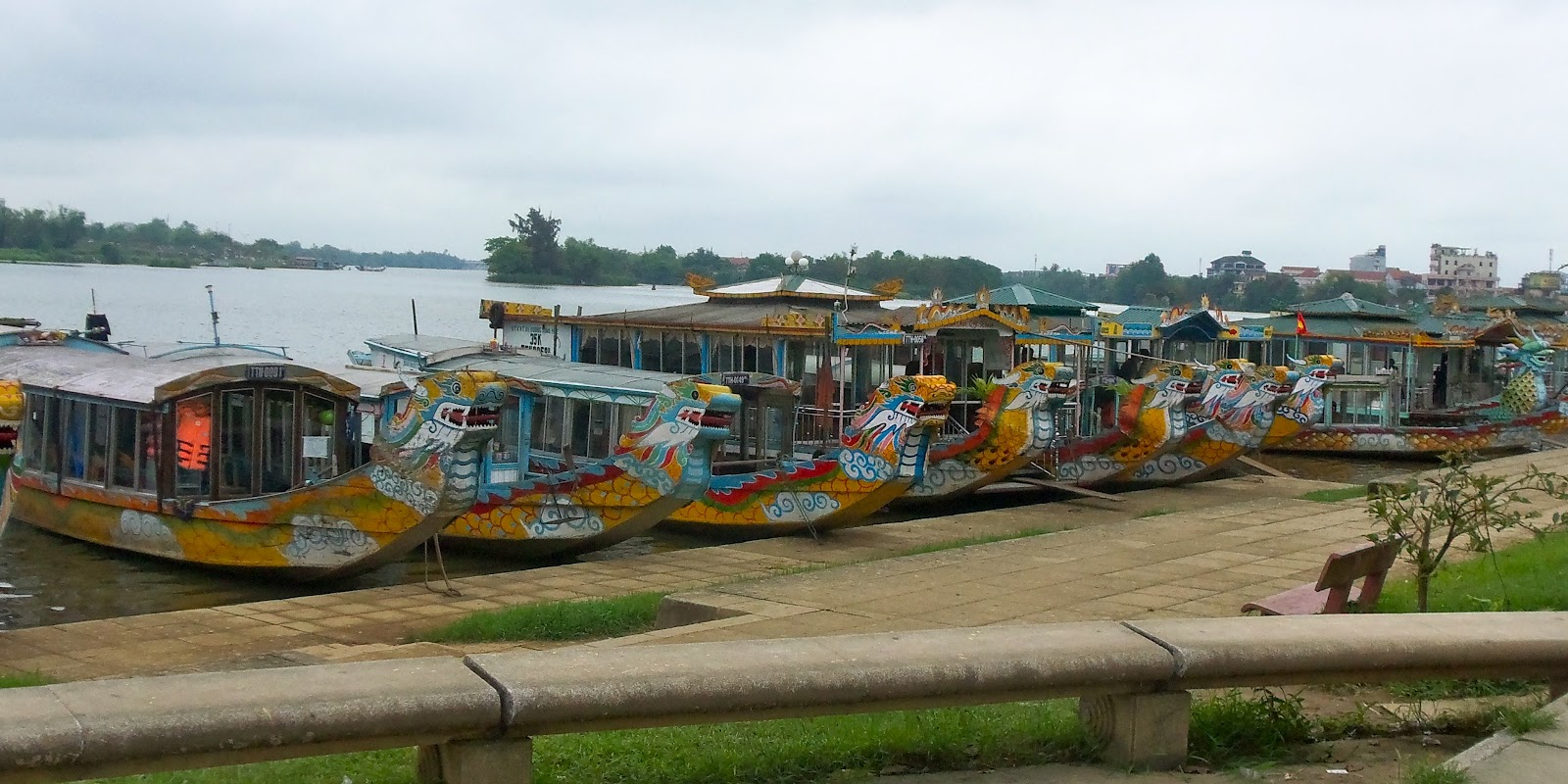
One thing that didn't change much from Hanoi was the gray weather.  It was a bit warmer as we took a stroll toward the Perfume River, hoping to get to the ancient Imperial City complex.  Several boats were lined up along the shore of the river, all looking of equally questionable riverworthiness status. 

The woman operating the boat offered us a ride across the river for a dollar a piece, so we climbed on board and enjoyed the short cruise to the other side of the Perfume River. 
The Imperial City dates back more than 200 years to when Hue was the capitol of Viet Nam.  A walled-fortress, the property is bounded by a perimeter stretching over two and a half kilometers.  Many of the original buildings were damaged or destroyed by the Indochina War and more so by the war with the United States in a bombing campaign in 1968.  Still, it was fascinating to walk around the massive complex and look at the ornate and detailed architecture.
The complex also featured the chance to, wait for it:  ride an elephant!  Of course, why not, what could possibly go wrong??  With a variety of worst case scenarios cruising through my head, I gallantly ceded my spot on the three-person gondola/death trap on top of the massive killing machine with legs as big as my entire body to my wife and kids.
All the elephant seemed to care about was getting a big stalk of sugar cane and once he had that firmly grasped between his jaws, he paid no attention to the goofy tourists on his back as he gave them a ten minute stroll around some of the grounds.

Hue was a good transition point on the way to our next destination of Hoi An.  More than one person we had talked to along the said Hoi An was their favorite spot in Viet Nam.  The train heading south doesn't go to Hoi An, only Da Nang, which is about a half hour drive away.  Our hotel in Hue offered us a car and driver for $45 for the three and a half hour drive, so instead of going through the hassle of booking train tickets then figuring out how to get from the train station in Da Nang to our hotel in Hoi An, we hopped in the car with a driver who spoke virtually no English and hit the road.
As often happens on a drive from the northern part of a country to the south, the sun appeared for the first time in over a week.  The road hugged some mountains just north of Da Nang, and provided a sun-splashed view of the bay, which was the entry point for thousands of US troops during the war.
The drive through and past Da Nang was fascinating in part because just south of the city we saw several resorts and signs of more in the works.  There was also signs of some developments that got started and never completed, which made us feel right at home as we pictured the hulking gray steel skeleton hovering over I-71 in Kenwood. 

Among the resorts were two of the golf variety, one of which was a Greg Norman design.  The other was the work of Colin Montgomerie.


It was certainly tempting to take advantage of the beautiful weather and play what looked to be a very attractive course, but with the family in the car, we continued to our destination of Hoi An.  The city dates back centuries and many of the buildings, while filled with shops and restaurants, are very well preserved.

The slower pace of Hoi An, especially in the city's older section, was a welcome change from the frenetic scenes we saw in Hue and particularly in Hanoi.  Walking along the ancient streets without having to dodge speeding motorbikes and scooters gave us a chance to exhale.  Our hotel was happy to have us add three nights to our stay as we decided to make Hoi An our home for almost a week.

Pretty much everything about the town worked well for us.  We walked around each day, shopping or finding a place to grab a bite to eat.  As the sun sets the atmosphere rises along the river.  Lanterns add a relaxing ambiance along the water, with people strolling along and vendors selling food and trinkets.

Our first night, we happened upon the scene after the sun had set, so we came back late in the afternoon the following day.  That gave us the chance to see the scene slowly change from day to night, as the soft fading light threw long shadows on the streets as the lights of the lanterns slowly began to glow.

The city has a certain serenity about it, some of which is probably attributed to its ancient soul.  Whatever the reason, it certainly captured our hearts and souls as we enjoyed the best of what Viet Nam has to offer.